
10 Pro Tips for Investment Casting Success: Slurry Control, Drying & Shell Building Guide
Master key techniques in investment casting with this expert guide. Learn how to optimize wax cleaning using ultrasonic generators, properly mix primary slurry with wetting agents and defoamers, control humidity during drying, and prevent shell cracking. Discover practical methods for checking slurry quality, managing moisture, and improving coating consistency for complex geometries. Whether you're dealing with deep holes, groove defects, or drying challenges, these actionable tips help enhance shell quality, reduce defects, and boost production efficiency. Perfect for foundry engineers and technicians seeking reliable, data-driven solutions.
heweifeng
1/26/20262 min read
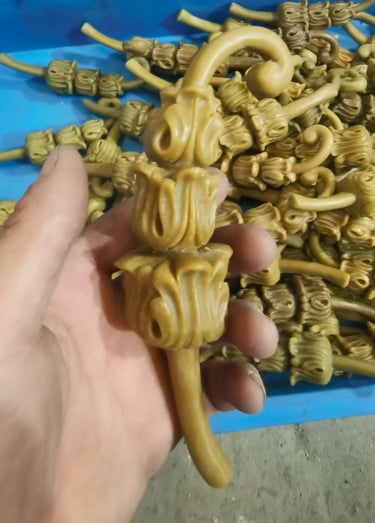

10 Pro Tips for Investment Casting Success: Slurry Control, Drying & Shell Building Guide
It is recommended to install an ultrasonic generator in the wax pattern cleaning tank, as it helps clean the mold assemblies more quickly and thoroughly. After cleaning, the patterns should be air-dried before coating to prevent cleaning fluid from contaminating the primary slurry.
If the primary slurry coating does not apply well, the quickest solution is to add a wetting agent. However, excessive use can adversely affect the slurry. Therefore, during slurry preparation, the wetting agent should generally be limited to 0.1%–0.3% of the binder's weight, not exceeding 0.5%. Similarly, the defoamer should generally be kept between 0.03% and 0.05%, with a maximum of 0.1%.
The mixing time determines the quality of the slurry. Longer stirring improves its coating performance. Ideally, manufacturers should use separate tanks for mixing and dipping to allow sufficient aging time. Water evaporation from the primary slurry promotes coagulation, so daily water replenishment is essential. To avoid oversight, a simple setup with a pure water bucket and a drip tube can be used, adjusting the drip rate based on daily water loss and replacing the bucket as needed.
A simple way to check if the primary slurry is coagulating is to stop stirring suddenly; if a milky film forms on the surface, the slurry may be nearing deterioration. Expired primary slurry can be repurposed for the backup or sealing layers. Alternatively, zircon flour can be washed out from the slurry for reuse.
In winter, when humidity control is challenging, localized humidity management can be adopted. For example, covering slurry suspension carts with plastic sheets helps maintain humidity and ensures quality for complex parts.
Primary layer drying requires high humidity, but the approach depends on the part's structure. For simple, flat parts without grooves or deep holes, humidity below 50% is acceptable, provided two layers are applied within a day to cover the primary layer quickly, rather than following standard drying times. Uniform and synchronous drying is crucial.
Several methods can check if the primary layer is dry. The scratch test is simple: if the surface feels hard when scratched, it is likely dry. A more scientific approach is using a moisture analyzer. During shell making, about 20% of solvents (including moisture) are lost, 64% during drying, and the remaining 16% exists as physical or combined water in the silica gel, mostly removed at 200°C. Residual combined water requires firing above 700°C for complete removal. Thus, drying aims to reduce the shell’s moisture content below 16%, which can be confirmed with a moisture analyzer.
Blowing off loose sand is critical during shell building, especially in deep holes and grooves, to prevent bridging. Before applying a new coating, use a rod of similar size to probe these areas, then remove loose sand with an air gun. For narrow grooves, filling with sand rather than slurry improves heat dissipation and reduces shrinkage porosity.
Mold assemblies should not be dried in fixed positions; regularly changing their location ensures even drying and prevents quality issues. For parts with deep holes or grooves, local air blowing or desiccants can aid drying and improve efficiency.
The sealing layer slurry should not be too thick; a powder-to-liquid ratio of 1:1 is sufficient. Ensure even slurry control without local accumulation to maintain shell permeability. After sealing, dry for at least 24 hours before dewaxing.
Before dewaxing, avoid placing shells in the dewaxing room for extended periods. They should enter the dewaxing autoclave immediately after removal to prevent cracking. Additionally, limit the number of shells loaded into the autoclave to avoid overloading and shell damage.
Feel free to share your own tips and experiences!
Quality
Precision manufacturing for diverse industrial applications.
Services
Products
+8615912702921