
Casting Defect Analysis: Is It Wax Ash or Something Else? A Practical Case Study
Discover how to diagnose casting surface defects through gating design and process review. This case study examines a flange defect, analyzes dewaxing and burnout conditions, and explains why it was likely trapped-air cold shut—not wax residue. Learn a systematic approach to defect root cause analysis in investment casting.
heweifeng
1/26/20263 min read
Casting Defect Analysis: Is It Wax Ash or Something Else? A Practical Case Study
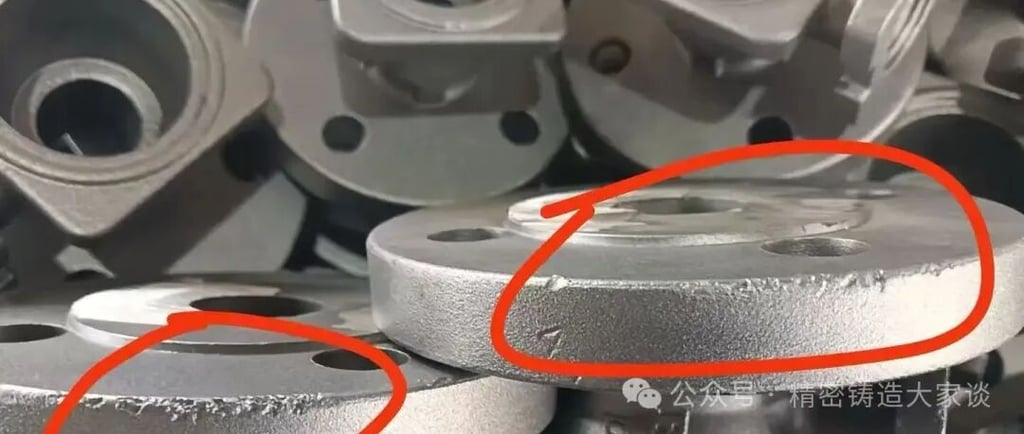
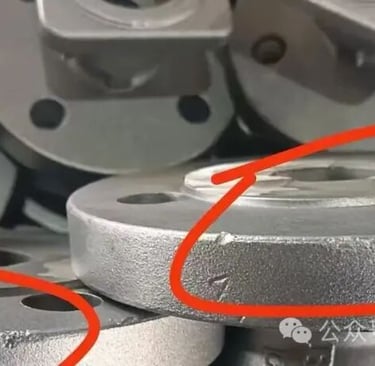
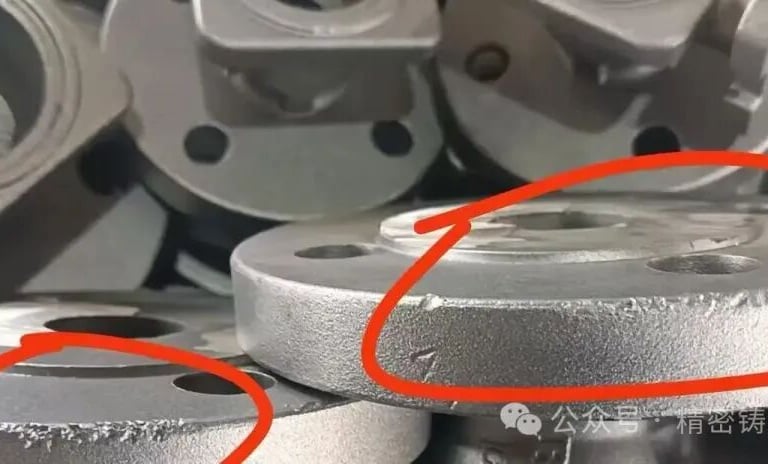
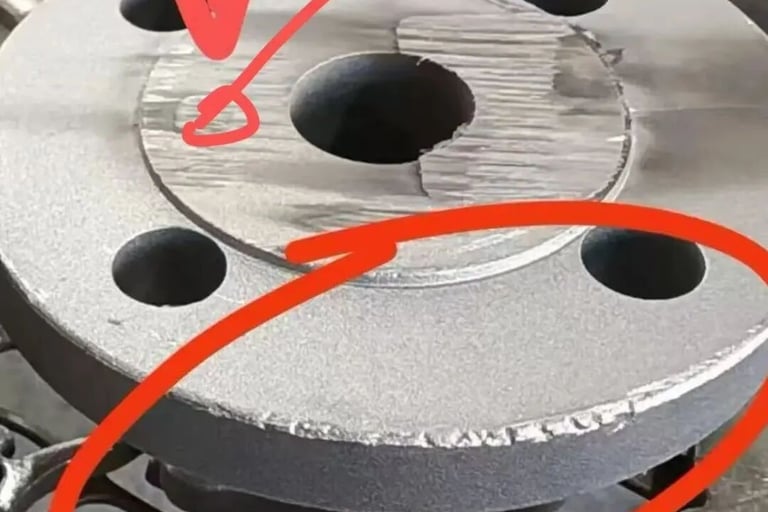
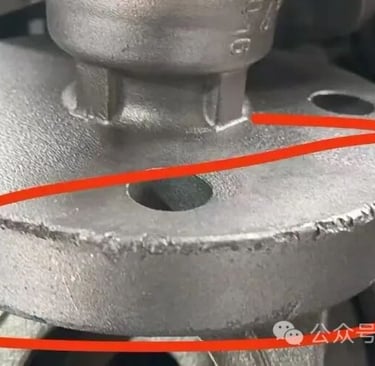
A colleague sent me a photo asking if the casting defect was caused by wax ash. Below are the two images he shared—Figure 1 and Figure 2.
Based on the appearance of the defect on the casting surface, it is difficult to definitively identify its type—it can generally be classified as a missing-material defect. As for whether it was caused by wax ash, we need to look further into the gating design and burnout conditions.
Figure 1: Missing material on the casting flange.
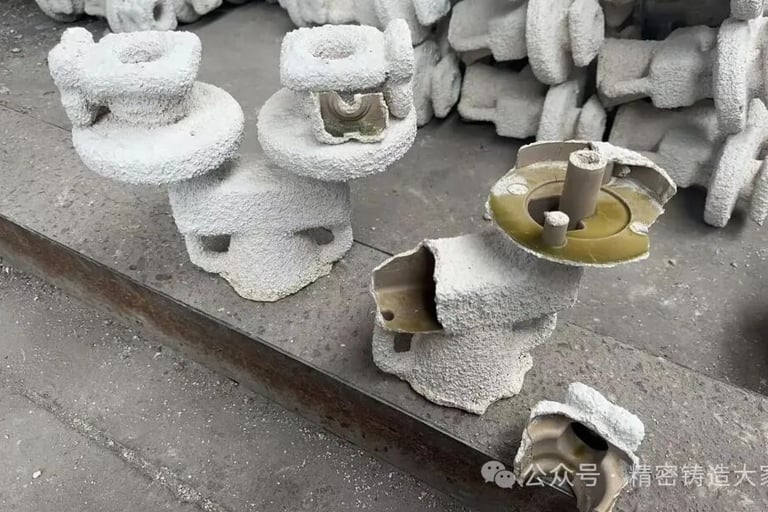
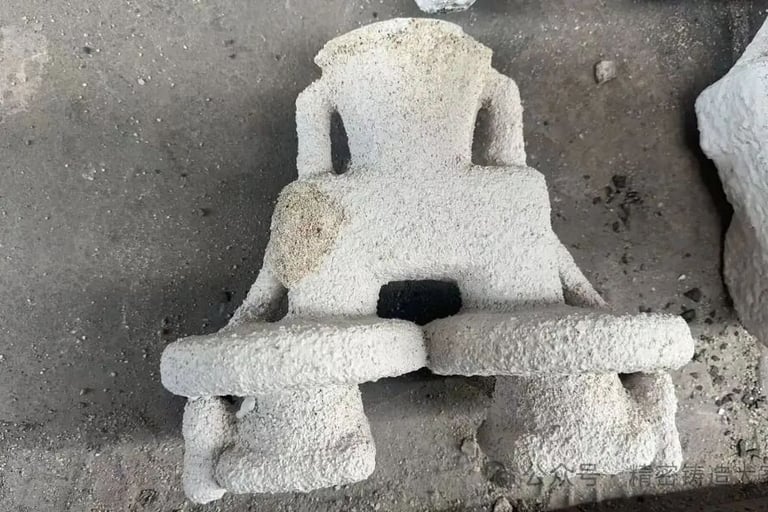
Figure 2: Gating system design of the casting.
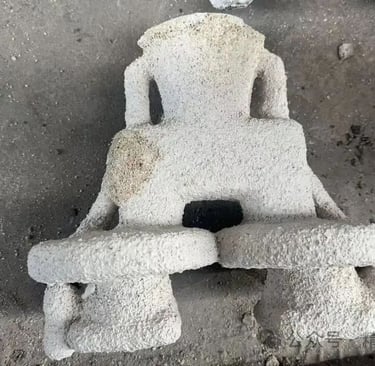
Normally, defects caused by wax ash tend to occur in fixed locations—specifically where dewaxing was incomplete. From Figure 2, it appears that residual wax remained across the entire flange surface, which satisfies the condition of incomplete dewaxing.
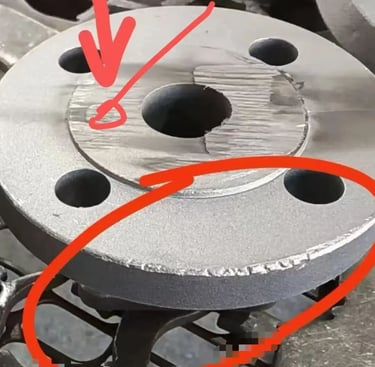
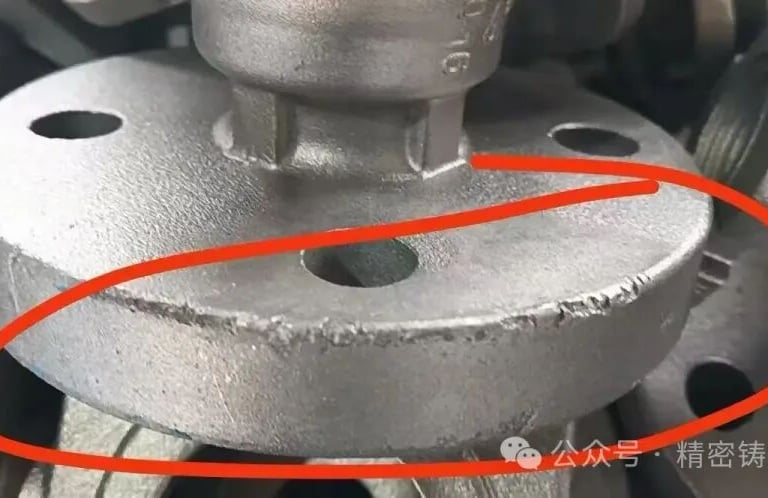
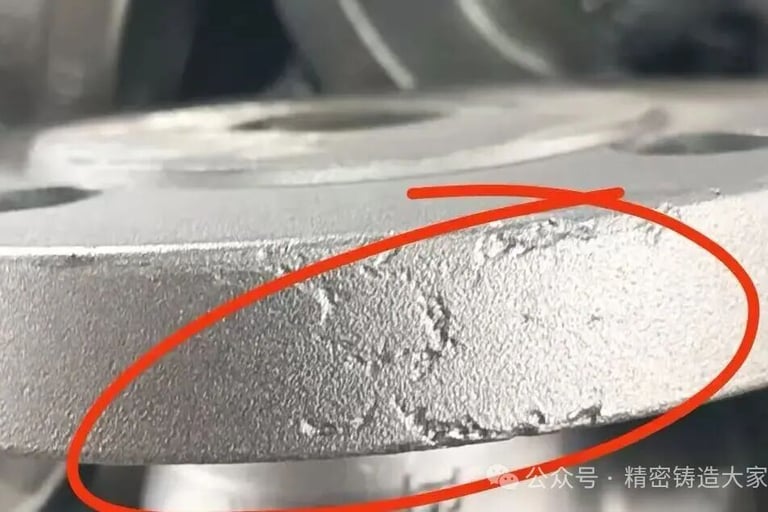
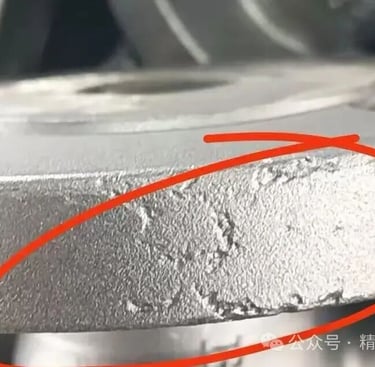
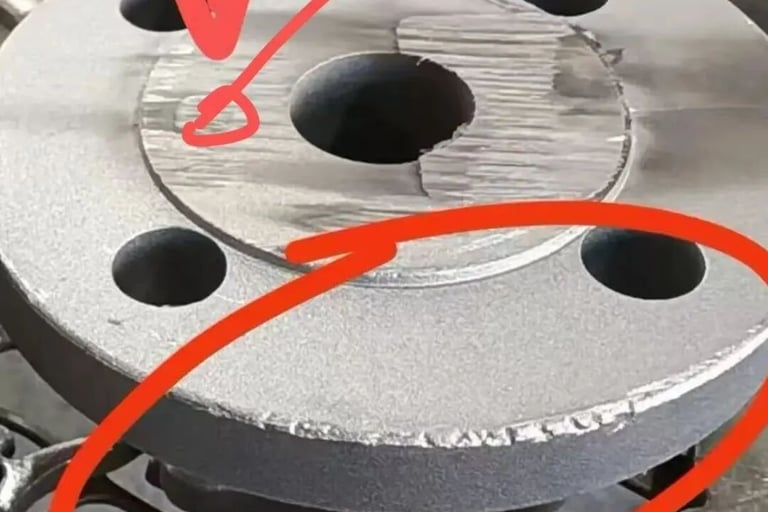
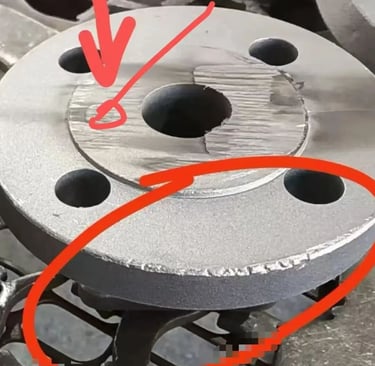
However, subsequent photos and the colleague’s description indicate that the defect did not occur in fixed positions—instead, it appeared along the edges of the flange, as shown in Figure 3, Figure 4, and Figure 5.
Therefore, based on the above, attributing the defect to wax ash seems unconvincing.
The second major indicator of wax ash-related defects is insufficient burnout.
He ruled this out, stating:
“Small parts are loaded and pre-fired in the morning, then fired again before furnace opening in the evening.”
“In the morning, the furnace is brought to 1100°C, held for a few minutes, and then shut off when leaving work.”
Additionally, the shell had only 5.5 layers and was not particularly thick. Hence, inadequate shell burnout is also unlikely.
Figure 3: Defect location on casting.
Figure 4: Defect location on casting.
Figure 5: Defect location on casting.
Thus, based on the two main criteria for wax ash defects:
Residual wax in fixed locations after dewaxing
Insufficient burnout of the shell
the defect in question does not appear to be related to wax ash.
Another point: the colleague mentioned that he tried reducing the shell to 4.5 layers, but the defect persisted. This further supports that burnout was not the issue—otherwise, reducing layers would have improved burnout and possibly eliminated wax-ash-related defects.
We must therefore reconsider and explore other possibilities.
From Figure 2 and another photo provided by the colleague (Figure 6), we can clearly see the gating design approach:
A top-gating system was used with two castings per cluster. Both the casting and the sprue included venting/wax-drain channels.
Figure 6: Gating system design.
Let’s revisit the defect location. Based on the images and casting orientation, the defect lies on the flange around the area below the ingate—essentially on the top surface of the casting (Figure 7).
Figure 7: Defect location on top surface of casting.
For top-surface missing-material defects, two common causes are possible:
Gas entrapment
Slag inclusion
Let’s examine which is more likely based on the gating design.
From Figure 6, molten metal flows from the sprue into the runner, slows down through a buffer zone, then enters the ingate. This design helps reduce turbulence and promotes slag flotation and gas venting.
However, when metal reaches the ends of the runner, it seals off both the ingate and adjacent wax-drain channels. Any gas trapped in the cavity cannot escape through these paths. If the shell has poor permeability, the gas will seek an exit—and the upper edge of the flange becomes the most likely location.
Additionally, the ingate is centrally located, so metal fills outward from the center toward the edges, conveniently carrying gas toward the periphery.
It is also worth noting that the pouring temperature was relatively low—only 1550°C–1580°C—and the casting contains holes, which further complicates filling.
Based on the above analysis, I believe this defect is a trapped-air cold shut.
What are your thoughts? Feel free to join the discussion and share your insights.
Quality
Precision manufacturing for diverse industrial applications.
Services
Products
+8615912702921