
Investment Casting: Fix Natural Core Shell Cracking
Struggling with shell fractures in investment casting? Learn proven techniques to enhance natural core strength, from better drying to compressed air methods. Boost efficiency and reduce defects in precision casting processes.
heweifeng
2/25/20264 min read
Mastering Natural Core Strength in Investment Casting: A Guide to Reducing Defects and Boosting Reliability
In the world of precision investment casting, natural core formation plays a crucial role in creating internal cavities like holes and slots in castings. However, issues like shell cracking due to insufficient strength can disrupt production efficiency. This guide explores key strategies to improve natural core strength, from shell-making quality to drying techniques, drawing on practical methods like compressed air assistance and reinforcement additives. This information is ideal for foundry professionals seeking to boost casting reliability and reduce defects.
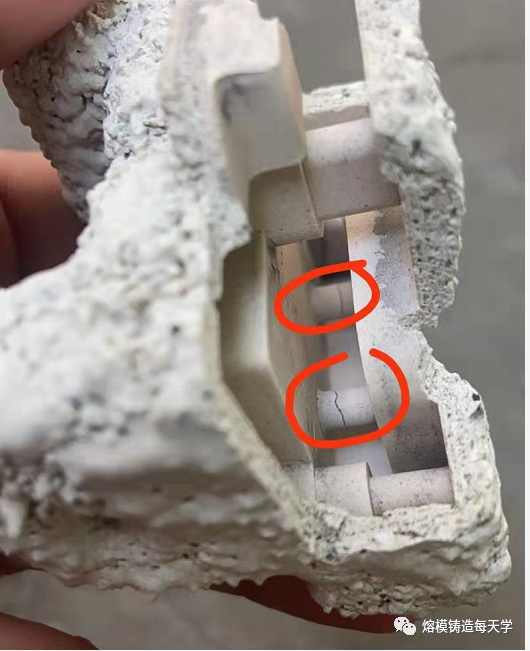
(Figure 1: Shell Core Fracture)
Understanding Natural Core Formation
These past few days, I've been deeply contemplating the issue of natural core fracture in shell-making production. But what exactly is natural core formation? It refers to the cores naturally formed through the shell-making process, used to create holes or slots in castings.
There are many ways to form these internal features, such as using mold cores, soluble cores, ceramic cores, or plaster cores. Among these, holes and slots formed by molds or soluble cores are typically finalized through natural formation during shell-making.
Additionally, there's another efficient approach: pre-shelling local holes or slots in the casting, drying them, and then incorporating them as formed cores into the wax pattern. This method reduces drying time in casting production and improves efficiency—a unique shortcut in the investment casting process.
Among these core-forming methods, ceramic cores generally offer better strength assurance. However, the quality of natural cores depends heavily on the shell-making process, actual operations, and drying conditions. Today, our main discussion focuses on how to ensure and enhance the strength of these natural cores.
The Two Pillars of Natural Core Strength
In a recent case, a colleague encountered a situation where the shell lacked sufficient strength, leading to a fracture—as seen in Figure 1. The strength of natural cores primarily depends on two critical aspects:
The Quality of Shell-Making: This is mainly about ensuring each coating layer is uniform, firmly bonded, and free from defects like missing layers or bridging.
Drying Conditions: Proper and thorough drying is non-negotiable for achieving target strength.
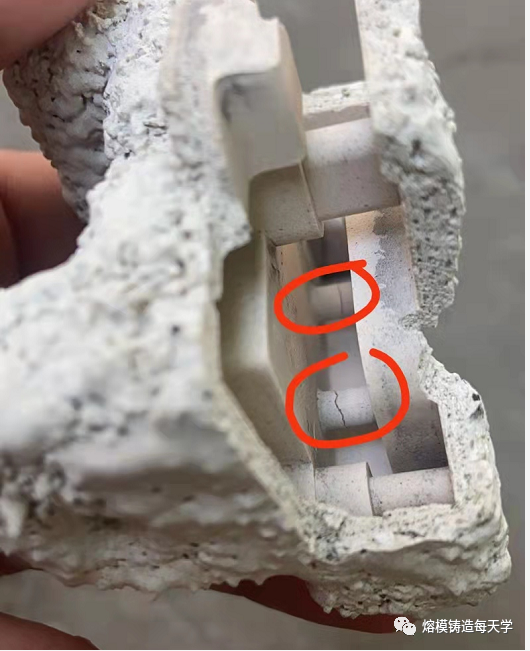
(Figure 2: Shell Core Fracture)
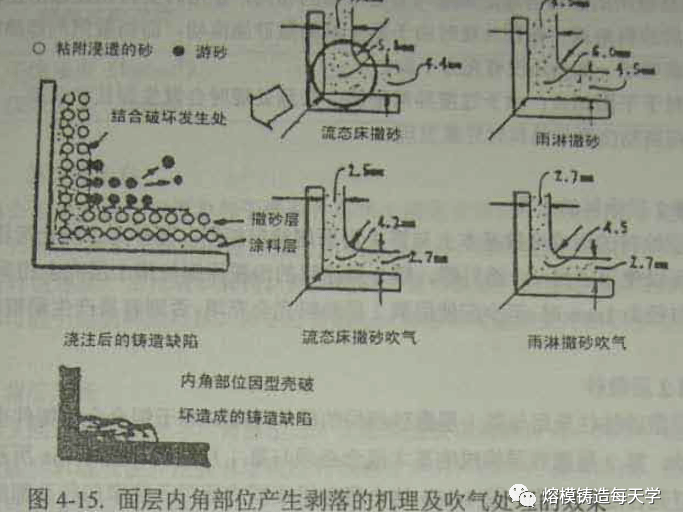
(Figure 3: Shell Core Fracture)
Enhancing Strength Through Shell-Making Quality
In terms of shell-making quality, operators must pay close attention to uniformity and bonding. It is vital to avoid missing layers or bridging, especially in complex cavities.
Operators should determine the appropriate coating viscosity and sand particle size based on the structure and dimensions of the holes or slots. For small holes and slots, multiple layers of low-viscosity coatings with fine particles may be required.
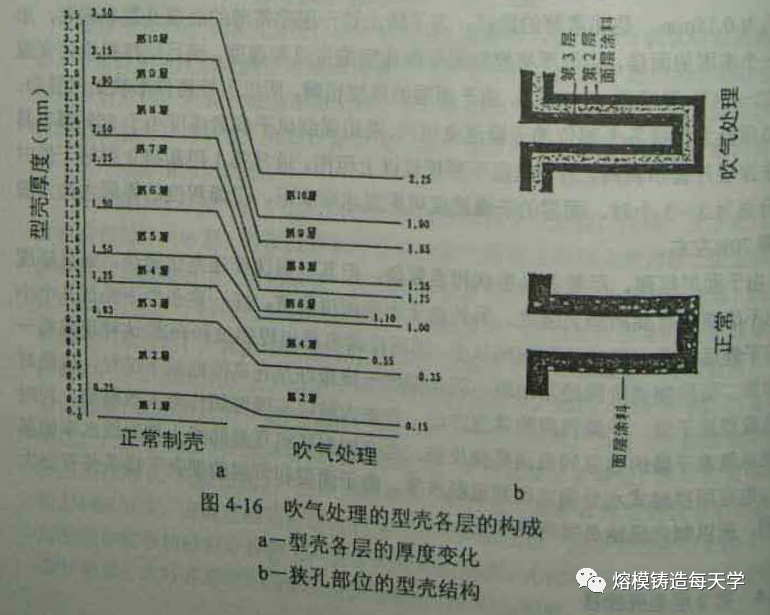
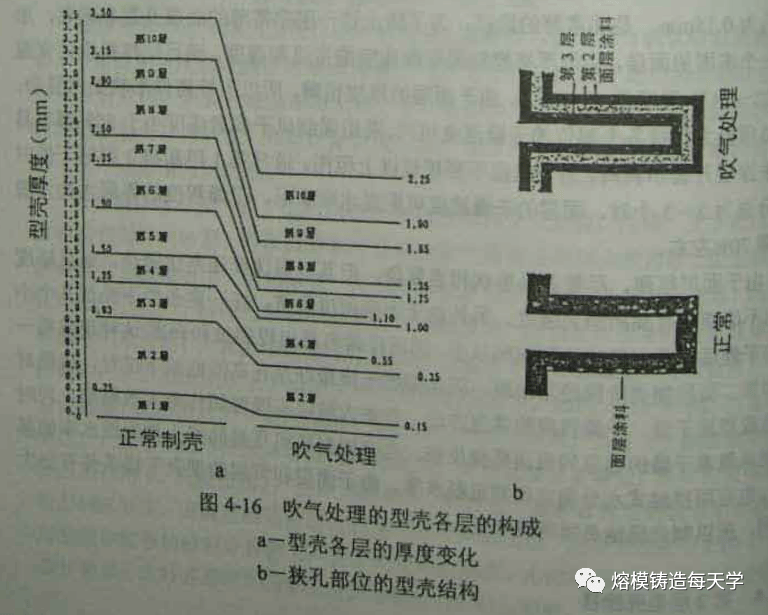
A key best practice is to promptly clean out floating sand from the holes and slots before and after each production step. If necessary, use compressed air to ensure every layer is properly applied. The following two images illustrate methods using compressed air to ensure uniform coatings and prevent missing layers.
(Figure 4: Shell Core Fracture)
The Impact of Using Compressed Air
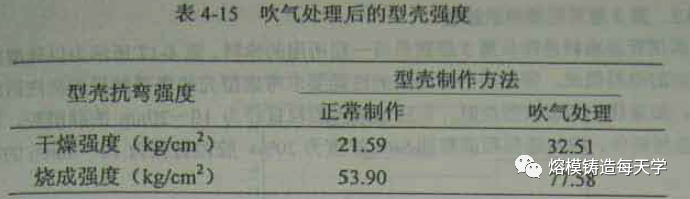
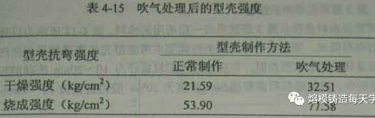
The effectiveness of this method is clear. Table 1 below compares the strength of shells made with conventional practices versus those using targeted air blowing.
(Table 1: Strength Comparison Between Conventional and Air-Blowing Shell-Making Methods)
From the data in the table, we can calculate that both dry strength and fired strength can be improved by 40% to 50% . This clearly represents a highly effective way to enhance shell integrity.
The Critical Role of Drying
Another key factor supporting shell strength is the degree of drying. The drying conditions inside a deep, narrow core are much more challenging than on the exterior and cannot be treated the same way as routine drying. The fracture situation described in the previous post falls into this category.
Therefore, special drying attention must be applied to the local shell areas of the core to lay a solid foundation for its strength. As we've mentioned before, this strength has a hereditary nature—if drying or shell-making quality isn't ensured, the subsequent wet strength and high-temperature strength will be significantly compromised.
Practical Methods to Reinforce Natural Cores
So, if you suspect the core needs strengthening or want to proactively improve its reliability, what can you do? Here are a few proven methods:
Adding Metal Short Fibers: In the book "Practical Techniques in Precision Casting" by Shanwu Yangshu, it describes using metal short fibers to enhance the backing layer and insulation. We can leverage this reinforcing effect. Sprinkling these fibers near the final backing layer can significantly improve the structure's integrity, especially when the casting wall is thin.
Inserting Core Reinforcement: At a certain stage of shell-making, you can insert items like wooden sticks or iron wires into the remaining holes of the core. Then, proceed with grouting the subsequent layers. This provides a mechanical backbone for the shell. Even if drying isn't fully sufficient in the deepest parts, this ensures that the shell won't fracture during dewaxing. I have used this method several times, and it is very effective.
Conclusion
While the addition of fibers or inserts is highly effective, they may not be entirely practical for high-volume batch production, as they can reduce efficiency. However, when you cannot immediately identify the root cause of core fracture or need a temporary solution, these methods serve as excellent, viable options.
By focusing on the fundamentals—uniform shell application, the strategic use of compressed air, and thorough drying—and by knowing when to apply reinforcements, foundry professionals can dramatically improve natural core strength, leading to higher casting reliability and fewer defects.
For reference only!
Quality
Precision manufacturing for diverse industrial applications.
Services
Products
+8615912702921