
Investment Casting Melting & Pouring: 10 Expert Tips to Prevent Explosions, Improve Degassing & Reduce Defects
Learn key techniques for melting and pouring in investment casting to enhance safety, metal quality, and casting yield. This guide covers how to prevent furnace explosions, maintain medium-frequency furnaces, optimize charging and deoxidation sequences, control pouring turbulence, and reduce shrinkage through targeted shell cooling. Whether you work with stainless steel, high-temperature alloys, or complex thin-walled castings, these practical methods help minimize defects, improve surface finish, and ensure consistent production results. Ideal for foundry engineers, metallurgists, and technicians.
1/26/20262 min read
Investment Casting Melting & Pouring: 10 Expert Tips to Prevent Explosions, Improve Degassing & Reduce Defects
As the saying goes, "Practice reveals mastery." By staying observant and curious, you can uncover many useful techniques in your own work. Today, let’s continue the conversation and explore some practical know-how in the melting and pouring stage of investment casting.
We often encounter furnace explosions (“bursting”), which are generally caused by moisture in the sprue wax patterns. Therefore, sprues should be preheated before use to allow moisture to evaporate. In some Taiwanese foundries, where austenitic stainless steel patterns are often water-cooled, such explosions occur frequently. As a rule, sprues with shrinkage cavities in the riser section are usually safe to use, while those without visible shrinkage should be baked before use to minimize risk.
Improper use of medium-frequency induction furnaces often leads to thyristor burnout. The main causes are rust buildup in the furnace's copper tubing and poor cooling water quality, which can easily trigger a shutdown. Operators should perform regular maintenance: blow away dust, check water hoses by touch, and immediately inspect any hose that feels hot—a sign of blockage. Timely cleaning ensures long-term stable operation.
When charging the furnace, arrange materials tightly at the bottom and loosely on top, avoiding overfilling above the induction coil to promote rapid melting. During melting, stir continuously to prevent bridging. The order of adding alloying elements depends on their melting points and oxidation tendency: elements with high melting points and low oxidation tendency (such as nickel and molybdenum) are added first, while easily oxidized elements like titanium and vanadium are added only after thorough deoxidation, typically during final deoxidation.
Pre-deoxidation is usually performed when the molten metal nears full capacity, which is also the time for composition adjustment. Common pre-deoxidizers include ferrosilicon and ferromanganese. Add ferromanganese first, followed by ferrosilicon—or add them together, but never in reverse order. Since pre-deoxidation is exothermic, the temperature should not be too high. Final deoxidation is done just before tapping, at a temperature slightly above the pouring temperature, followed by a holding period to allow deoxidation products to float. Deoxidation is essentially a refining and cleansing process for the molten metal.
The effectiveness of deoxidation can be checked. Take a ladle of molten metal and pour it into a small container (often the same mold used for composition testing). If the sample surface bulges significantly, deoxidation was inadequate and should be repeated. A concave surface indicates good deoxidation, while a flat surface suggests further deoxidation is needed.
For castings with localized hot spots where gates cannot be easily added, you can spray or quench the corresponding areas of the shell with water immediately after it exits the preheat furnace. This significantly reduces shrinkage porosity. However, remember: quenching before pouring and quenching after pouring yield completely different results. Quenching after pouring may cause pitting defects and reduce surface quality.
In the preheat furnace, the open riser areas of shells tend to collect sand and dust. Placing a simple compressed-air dust collector at the furnace entrance is very effective for cleaning debris from inside the shell.
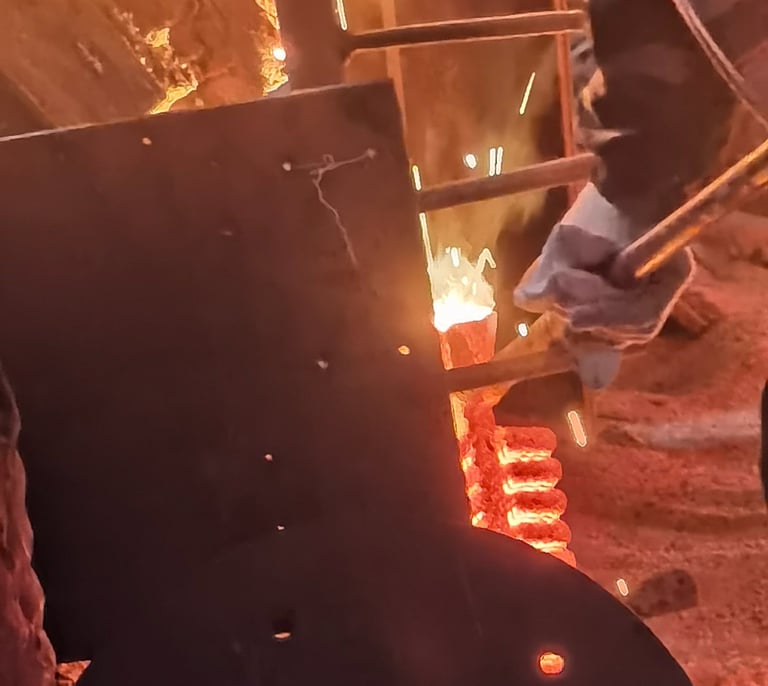
Before pouring, place a piece of insulating fiber blanket around the furnace spout. This helps maintain metal temperature and filters out slag from the metal surface—a simple yet effective step, especially for parts requiring polishing.
During pouring, keep the furnace spout as close as possible to the pouring cup. This minimizes turbulence and promotes near-laminar flow, which helps with slag flotation and gas venting, thereby reducing slag inclusion and gas holes—key to improving casting quality.
We welcome everyone to share more hands-on insights from various stages of the investment casting process.
Quality
Precision manufacturing for diverse industrial applications.
Services
Products
+8615912702921